Showing posts with label Siena. Show all posts

Saturday, September 7, 2013

Estate 2012 (Summer 2012)

I realize that it's September now, but it still feels like summer to me!  Temperatures in Italy are still quite hot (today it hit up to 93 degrees in Signa), so I thought that it would be a good time to do a summertime wrap-up post.

MUSICA (Music)

As usual, summertime provided us with some great music to use as a seasonal soundtrack.  Here are some of the ones that I gravitated towards:

JOVANOTTI - Ti Porto Via Con Me

I absolutely love this song.  Every time I hear it, it reminds me of all the little trips that Simone and I took this summer.  "Ti porto via con me", translates into "I'll take you away with me".  We heard it a lot this summer and it continues to put a smile on my face every time I hear it.  Jovanotti tends to have that effect on me though!


JOVANOTTI - Estate

Yep, another one from Jovanotti.  I can't help it!  His songs are usually so cheerful, and "Estate" doesn't disappoint!  "Estate" is Italian for "Summer", and  you can definitely get the "summer" feel from this song.


MAX GAZZE' - Sotto Casa

I can never not like a Max Gazze' song.  I think it's impossible.  He was the first Italian artist that I really started to follow more than 3 years ago.  His "Sotto Casa" is such a catchy, up-beat tune.  It was a no-brainer to include this in my personal summertime soundtrack!


CHIARA (Feat. FIORELLA MANNOIA) - Passi

Two of my favorite female artists in one song.  "Passi" was one of my 'chill out' songs of the summer.  (Note, this isn't an official video, but one I found on YouTube.)


CIBO (Food)

Summertime is when we enjoy fresh, in-season vegetables as much as possible, and foods that are not so "heavy".

PANZANELLA

Nothing says summer to me more than a nice, cool salad.  In Italy, that means panzanella.  Tuscan bread, fresh tomatoes, cucumber, red onion, parsley, white wine vinegar, and olive oil combine to make an amazingly refreshing lunch!


GRILLED FOOD

Hot summers mean grilling meat in most parts of the world.  Italy is no exception!  Steak, fish, chicken, vegetables and pork all make an appearance on local grills.  We grilled some lovely pork chops earlier this summer, rubbed with fresh sage and rosemary, and accompanied with fresh asparagus cooked in a wonderful olive oil and some cooked apples.  Our neighbors asked what it was we were cooking because it all smelled so delicious!


SAGRE (Food Festivals)

Summertime sagre are everywhere in Italy.  Not a weekend goes by without at least two or three being held somewhere within an hour's drive.  We visited a few this summer: chinghiale (wild boar), porcini (mushrooms), and ranocchi (frog legs).

Fried ranocchi!  Delicious!

FRUTTI DI MARE (Seafood)

Summer means lighter foods, which in my book means fish and seafood.  We at a LOT of mussels this summer.  We would buy them at the supermarket which had them for less than 4 euro per kilogram.  We'd get a kilogram and split them between two meals.  They were super delicious and a great bargain!  We got several different fish over the course of the summer as well, frying some and poaching others.  


GELATO

It's not summer (or fall, or winter, or spring) without gelato!  We enjoy eating gelato year-round (obviously), but in the summer, it's extra fabulous.  Whether visiting a gelateria or buying a tub at the supermarket and eating it at home, it's a summertime staple.

caffè, fior di latte e nocciola gelato
coffee, sweet cream and hazelnut ice cream

VIAGGI (Travels)

It wouldn't be summer without taking a few day-trips!  We hit the road several times this summer.  Here are a few of the places we visited:

LA SPIAGGIA (The Beach)

The summer started out rather cool, but by mid to late June, it was getting rather warm, so we hit the beach.  The Mediterranean is absolutely gorgeous.  I'm not a real beach-lover, but even I really enjoyed digging my feet in the sand or wading out a little and letting the waves lap up against my legs.  The beaches we have gone to have all been extremely clean...and free!  Crowded, but not too bad.  If we lived closer, I'm sure we would have gone more often!


SIENA

We visited Siena twice this summer.  We both really love that town and enjoy spending time wandering around it's ancient streets.  The folks there are friendly and there is a real sense of community there.  The hilly streets can be a bit of a challenge on super-hot summer days though!


ROMA

This was the first time that either of us had ever been to Rome!  It was a short, whirlwind trip, but we saw a lot of really great things.  Unfortunately, not nearly as much as we had hoped to see.  Guess that means we'll need to go down again and see the things we missed!  Next time, I think we will try to go when it isn't the busy summer tourist season.  There were a LOT of tourists there!


LE MONTAGNE (The Mountains)

Another good way to beat the heat is to take a drive up to the mountains!  We visited Abetone once and climbed up to the top of the mountain, which rewarded us with spectacular views.  We visited lower mountains near Pistoia on several occasions.  The temperatures are cool and refreshing...and the views are amazing.

The mountains of Pistoia

FESTE (Festivals)

Italy knows how to put on a great festival!  There always seem to be some sort of festival going on every weekend & I've not been disappointed yet!

FESTA MEDIOEVALE MALMANTILE (Medieval Festival in Malmantile)

A medieval festival in an actual fortified medieval village.  It doesn't get much better than this!  Craftsmen demonstrating their skills, vendors displaying their wares, medieval goodies and treats...and did I mention that people still actually LIVE in this castle-like village?

Candle making demonstration at Malmantile

LA FESTA DI SAN GIOVANNI (The Feast of St. John the Baptist)

St. John the Baptist is a pretty big deal in Florence, since he is the city's patron saint.  So what else do they do but throw a huge bash on his birthday!  The day starts with mass, continues with the final of the Calcio Storico (except for this year...it was postponed due to a thunderstorm that passed through the area in the afternoon), and ends with a spectacular fireworks display over the Arno.


FESTA DEL PANE DI PRATO (Festival of the Bread of Prato)

Prato's Piazza del Duomo transformed into a carb-lover's dream this past June with it's Bread Festival!  They put up some ovens and baked fresh schiacciata (and handed out pieces for free).  There were several booths from bakeries and flour mills present, selling and displaying their wares.  I tried so many baked goodies, I ended up skipping lunch!


These are just a handful of things that we did this summer.  Of course, we did more than just the above.  We spent a lot of time walking in Cascine or around other parks and areas around the neighborhood.  We enjoyed the good weather and tried to avoid the bad weather (one day when it was raining buckets in the Florence area, we headed down to Empoli and Vinci just because it wasn't raining there!).  We worked a lot and we played a lot.  That's what I love about Italy!  There is always something exciting going on!

Saturday, August 31, 2013

Visit to the Duomo di Siena

For our second trip to Siena, we decided to take a tour the Duomo, so Simone bought us an all-inclusive ticket that got us into the duomo, the baptistery, the crypt, the museum, and allowed us to climb up to the terrace of the Facciatone (the unfinished facade to the "New Duomo", a huge project that was abandoned after plague hit the city).


Siena's duomo is gorgeous, and that's putting it mildly.  They started building it way back in 1196, it was consecrated in 1215, and the front facade was finished sometime between 1360 and 1370, although some additions were made over the ages.  The intricately carved marble and brilliant mosaics are absolutely stunning.  Both the exterior and interior boast the beautiful white and black/green marble in horizontal stripes.


A close-up view of the center mosaic

Upon entering the duomo, I was struck by the fact that I really didn't know where to look first!  The soaring gothic interior, rising up to the gorgeous dome?  The incredible mosaic floors?  The countless works of art?  It was actually a bit overwhelming!  


The inlaid marble mosaic floor is incredible.  When we were there, much of it was covered with rugs (probably to keep it safe from the millions of visitors walking around), but right now, between 18 August until 27 October, if you are in Siena, you can see the entire mosaic floor without any of the carpeting.  They uncover the floor each year around this time for a few weeks, so if you're thinking of taking a trip out there someday, keep that in mind!  These magnificent mosaics were laid beginning in 1372, a section (or panel) and a time.  The last panel was added in 1547.  There are 56 total panels on the floor, covering pretty much the entire floor of the duomo.  


The striped walls and pillars reaching up toward the gorgeous ceiling are spectacular.  The vaulted ceiling is blue with gold stars, emulating the heavens.  The large golden decorated dome takes its place in the center of the church, making it impossible to miss.


There is beauty absolutely everywhere you turn in this cathedral.  There are works by Michelangelo, Bernini, and Donatello, among others.


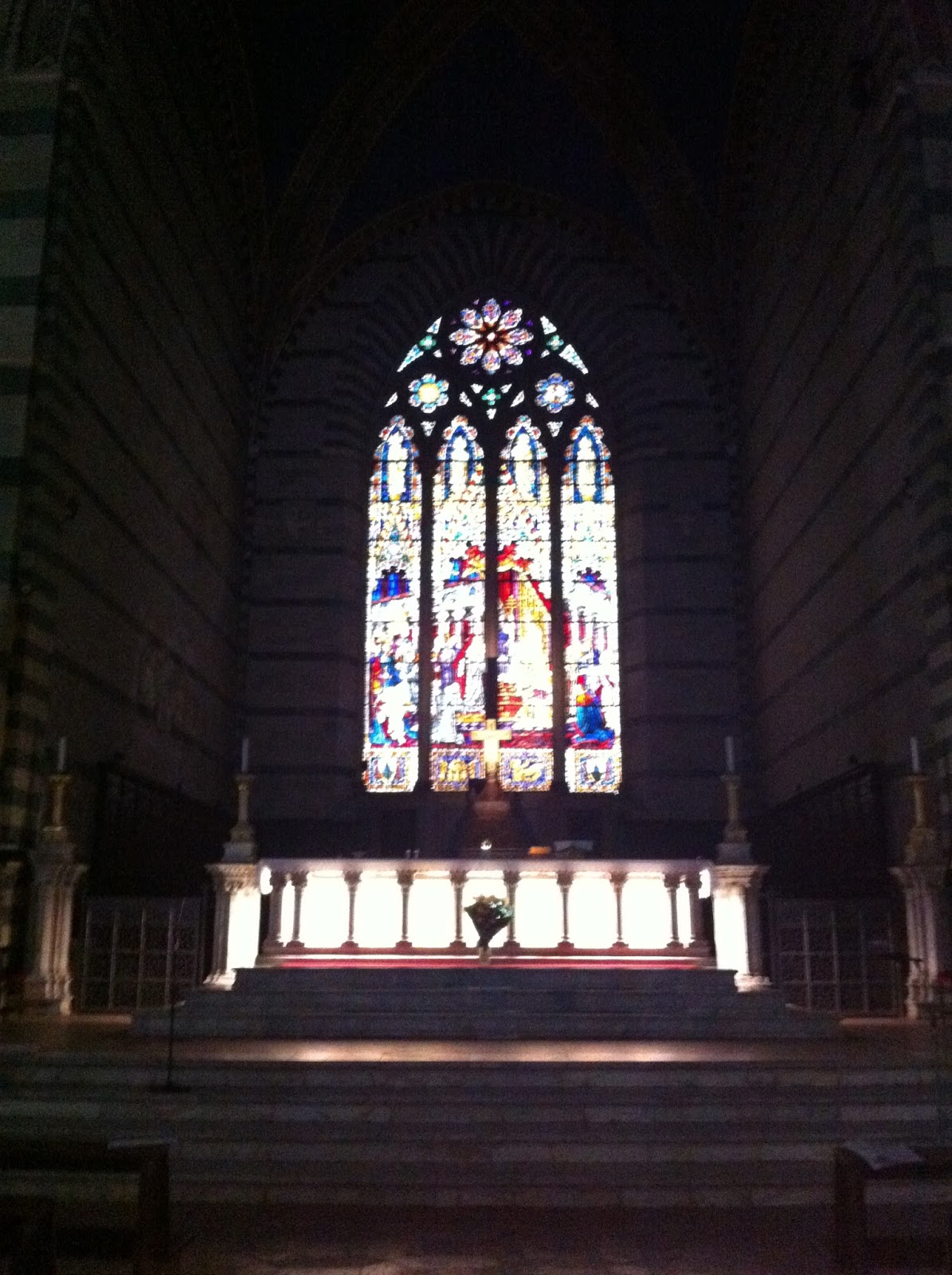
The main altar

Looking toward the front entrance from in front
of the main altar

The pulpit


Part of the library room
After we toured the duomo, we headed over to the museum (no photos were permitted) and then climbed up to the Duomo Nuovo to view a gorgeous panorama of Siena and the countryside surrounding it.  The Duomo Nuovo (translated "new duomo"), was supposed to be a huge addition onto the cathedral.  Building started in 1339, but was halted in 1357 due to the devastating Black Plague.  What remains today is Facciatone (facade) and what was to be part of the nave, which is now where the museum is located, and a wall opposite which was used to build the Palazzo Reale.  

The views are stunning to say the least.

Looking down on the Piazza Jacopo della Quercia and the Duomo

Looking down toward the Piazza del Campo and the Torre di Mangia

Looking out over the countryside of Siena
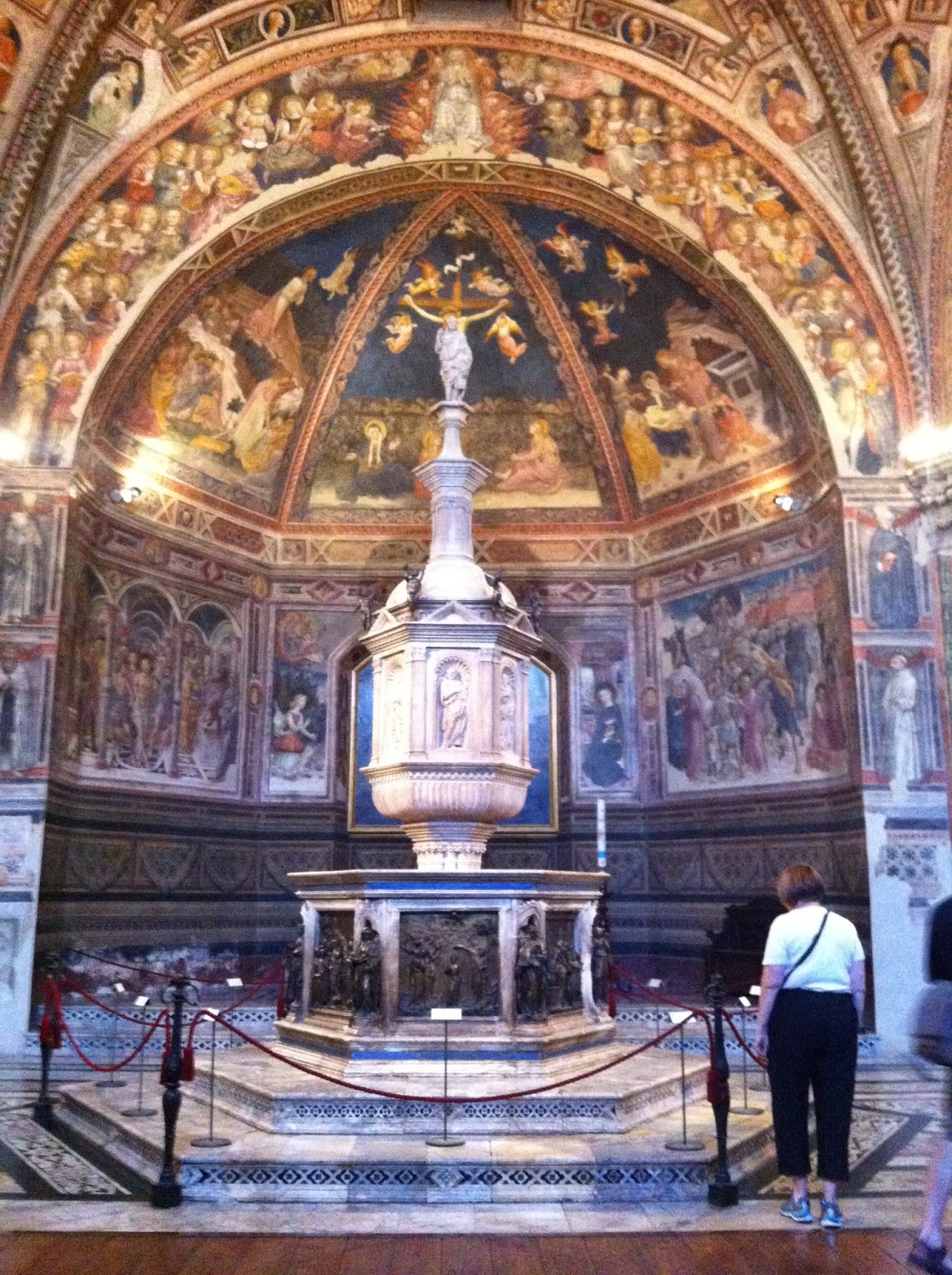
The baptistry was next on our agenda.  Siena's baptistry was built between 1316 and 1325 by Camiano di Crescentino.  It's a rectangular building, located right next to the duomo.  Funny thing about the history of the baptistry, it was built in this location because back in 1317, it was decided to lengthen the choir of the cathedral.  The cathedral, however, was already built near the edge of a hill, so they needed to build something that would support the expanded choir from below.  So, they decided to build a new baptistry in order to do so.  


The baptismal font is absolutely exquisite.  It's made of marble, bronze and enamel and was created by several famous sculptors:  Donatello, Ghiberti, Giovanni di Turino, Neroccio, and Jacopo della Quercia.  

The ciborium in the center of the font

The hexagonal basin of the font with its bronze panels

 The ceilings are covered with beautiful, brightly-colored frescoes depicting Apostles, Articles of the Creed, and various biblical stories.  These were painted by Agostino di Marsiglio, Vecchietta (who also sculpted the ciborium that is placed on the high alter in the Duomo), Michele di Matteo Lambertini, Benvenuto di Giovanni, and Pietro degli Orioli.


On the wall to the left, there is a gorgeous i Brescianini painting titled "Battesimo di Cristo".


Above the side alter on the left, there is this statue of Christ that I got a kick out of.  To me, it appeared that he was there, just hanging out.


The main altar, located directly behind the baptismal font, is made of beautiful marble.  Above it is a fabulous painting by Alessandro Franchi, titled "il Battesimo di Gesu" (The Baptism of Jesus).  


After we left the baptistry, we stopped by the Oratories of San Bernadino.  We weren't allowed to take pictures there, or at the crypt where you can see the ancient frescoes that were a part of the original church that was on that site.  

Touring all of these sites took a few hours to complete.  I believe they say that the fastest you can possibly get through all of the sites that are on the Opa Si Pass (the multipass that we bought - only 12 euro!) would be around 2 hours.  We took our time though, and it took us quite a bit more time than that, but then we also stopped for a cold drink at one point, and took our time walking from site to site.  

If you visit Siena, this is a must-see.  There is so much to see - I could fill a book with the photos that I took (the ones I posted here are a tiny fraction of what I have)!  Really, though, photos are nice, but to see it with your own eyes is much, much better.  

Tuesday, August 27, 2013

Siena

Simone and I visited Siena a couple times this summer.  I had never been before and didn't know too much about it, but Simone wanted to show it to me, so beautiful Sunday afternoon in early July, we took the hour and 15 minute drive to Siena.


It was crowded.  It was really, really crowded.  All the parking places were overflowing.  Finally, thanks to a street vendor pointing out a spot, we parked.  (Now how "legal" the parking was, I don't know.  But we didn't get a ticket or anything, so it must have been either legal enough, or overlooked.)  

We walked into the city and after about 30 minutes, we discovered why it was so crowded.  Every year, on 2 July and 16 August, the city holds the Palio di Siena - a horse race conducted in the Piazza del Campo, which is the large, main piazza of the city.  We happened to be there on 1 July - the day before - when they hold a trial run in the evening.  

We discovered this fact while enjoying a cup of gelato at Nannini.  They had the television playing the news, which showed the thousands of people gathered in the piazza, waiting for the trial run to start. After we finished our gelato, we walked over to the piazza to see for ourselves.  It was PACKED.


 It was too crowded for me.  Simone kinda wanted to stay to watch it, but I was a party-pooper and vetoed that idea.  I don't like crowds that much, and this was a HUGE one.  It was warm and the thought of being squished in the center of the piazza like a sardine didn't appeal much to me.  Looking back on it, I kinda wished we would have stayed though.  Maybe next year we'll go back to experience it.

We did get to see some Carabinieri in their dress uniforms riding horses though.  They traditionally take a couple laps prior to the start of the race with swords drawn.  They did look pretty impressive.


The palio, as it is today, has been going on since 1656.  There are 17 neighborhoods, or contrade, in Siena, and each of them gets a horse into the race.  Well, kind of anyway.  There are only 10 horses run in the palio.  In the July palio, the seven contrade who weren't in it the year prior, automatically get placed and the other three places are decided by a drawing held in late May.  Then in August, the seven contrade who didn't run in the July palio will run, along with three that were decided by a drawing held in early July.  The winner of the palio is the horse (with or without the rider) who crosses the finish line first after three laps.  The jockeys ride bareback, using only a bridle and reins.  It gets pretty intense and exciting, from what I understand

We walked around the city for a bit and the streets were fairly empty (since everyone and their brother was at the palio trial).  The trial was over quickly though, and soon we saw a flood of people leaving the piazza.


A  bit later, we found ourselves on a side street and witnessed the procession of the contrada who won the trial race that night.  It was led by the horse and followed by a huge group from the contrada, surrounding the jockey, and singing the Verbena (which is a Sienese anthem), or rather, their version of the Verbena.  Each contrada seems to create their own version of the song, with words changed to suit their contrada.  


The very next week, we returned to a much less crowded Siena.  The weather was clear and beautiful, but it was a bit warmer.  We stopped by a little alimentare and bought a couple panini for lunch.  The owner was so nice, he had an ice-cold water dispenser in his shop and gave us a couple cups and told us that the water was free and if we got hot later to come back and get some more!


Most of the day, we spent touring the Duomo and a few other spots related to it (the baptistery, etc), but I'll save that for another post.

We walked into the Piazza del Campo, which was all cleaned up from the palio race the week before.


Before we walked into the Palazzo Publico, a band of drums and flags walked by.


We didn't stay long in that area, since we were hopping from site to site on our multipass.

We did end up visiting another church that was not on our multipass that day while we were there that day - The Basilica di San Francesco (this one was free to enter).


This amazing church was built between 1228 (two years after the death of Saint Francis) and 1255 (later expanded in the 14th & 15th centuries).  The interior is rather simple, mostly due to a fire that ravaged the building in 1655, however, to me, it seems appropriate, due to the simplistic nature of the Franciscans.

The lunette above the main door depicting San Francesco
and San Bernadino in adoration of the Virgin and Christ child
The interior is very dark.  Extremely dark.  Not very many electrical lights at all, so unfortunately my photos didn't turn out very well (I only had my iPhone with me to take pictures with).

The view entering the basilica

Looking toward the main door

The main altar

One of the side chapels

Another side chapel

Apparently the basilica was part of a miracle back in August of 1730.  On the 14th of that month, 351 consecrated Eucharistic wafers were stolen from the church.  Three days later, they were found, placed in the poor box of a nearby church (Santa Maria di Provenzano).  The wafers were in perfect condition, but the box that they were contained in was full of dust and cobwebs, so obviously they were not going to use them in communion.  They decided to keep the wafers, and after more than 280 years, they are still intact and look the same as they did back in 1730.  This might not seem so miraculous, but normally these wafers would have disintegrated within 2 years.  In 1914, they conducted a series of tests that showed no presence of bacteria, mites or mold, and were still composed of unleavened bread flour.  The ciborium (the container that holds the wafers) was tested and the interior DID in fact have bacteria, mites and mold.  Because of this, the Church declared that it was because the wafers were consecrated, and therefore were transubstantiated into the Real Presence of the Body of Jesus Christ.  Today, these miraculous wafers are still held in the basilica, housed in one of two chapels in the church.

A photo of a photo of the miraculous hosts

After we visited the basilica, we decided to stop by our favorite gelato chain, Grom, and cool down with a cone.


It was, as usual, fabulous.

After we left the shop, our tummies filled, it got a bit bizarre.

As we stepped out of the shop, a parade broke out.  Right in front of us!


Led by a drummer and flags, we quickly figured out that it was the contrada of Oca celebrating their win of the palio the week prior.

The entire contrada (neighborhood) must have been in the parade.  It was extremely long and had folks of all ages.  From babies....


...to school age children...


...to teenagers...


...to young adult/college age kids...


...through middle-aged and elderly folks!


EVERYONE was there!

These guys were handing out free panini (sandwiches)

This group of guys were handing out cups of wine

I got one, of course  :)

Later, this guy rolled up with a huge cask of wine in the back
and refilled everyone's cup!  (Viva Italia!  Viva Siena!)


It was basically one hell of a party!


I was certainly ready to move to Oca after that!  It was really neat to see the whole neighborhood be a part of such an amazing celebration!  I know that we will definitely be back...many, many times!