La Festa di San Giovanni was this past week (19 March) and to celebrate, I made some delicious zeppole and posted the recipe on my other blog, La Vita Toscana.
Zeppole are not typically Tuscan - they are found more in the southern part of Italy. However, they are delicious and rather easy to whip together.
Try it for yourself. You can find the recipe and instructions at http://tuscanlife.blogspot.com
Buon appetito!
Showing posts with label Italian food. Show all posts
Sunday, March 23, 2014
Monday, September 23, 2013
Ribollita
Now that it's officially autumn and the temperatures are finally getting to be cooler, it's time to start making those warm, delicious, hearty, comfort foods again. Yay! I absolutely love the heartier foods that are made in Tuscany and I look forward each year to be able to whip up all the yummy soups, stews, and roasts that come to mind around this time! One of my favorite dishes (and a favorite of my Toscano) is ribollita.
Ribollita is "peasant food" at its best. The name comes from the fact that originally it was basically minestrone soup that was "re-boiled" the next day with the addition of leftover bread. Today's recipes for ribollita rarely call for it to be "re-boiled", but it is still a very inexpensive, yet hearty and delicious meal!
To make ribollita, you need a big pot, a lot of vegetables and some bread.
Start out by chopping up your vegetables. You'll need some onions (I used red onions here, but you can use yellow onions if you prefer), garlic, carrots, celery and parsley at this point.
Ribollita is "peasant food" at its best. The name comes from the fact that originally it was basically minestrone soup that was "re-boiled" the next day with the addition of leftover bread. Today's recipes for ribollita rarely call for it to be "re-boiled", but it is still a very inexpensive, yet hearty and delicious meal!
To make ribollita, you need a big pot, a lot of vegetables and some bread.
Start out by chopping up your vegetables. You'll need some onions (I used red onions here, but you can use yellow onions if you prefer), garlic, carrots, celery and parsley at this point.
After you get done chopping these vegetables, pour some extra-virgin olive oil in a big, deep pot and add your chopped veggies. Stir them around so they don't stick and season with some salt and pepper.
Let it cook for 20 minutes and be sure to stir it often. You really don't want this to stick to the bottom of your pan. (If you need to, add a little water.)
Your vegetables are going to end up nice and soft with a slight golden color.
At this point, you'll need to add some crushed tomatoes.
Did I mention that this is going to start smelling amazing? Mmmm!
Stir the tomatoes in and let them cook for about 5 minutes or so. They just need to lose that "raw tomato" scent.
While that's cooking, drain your cannellini beans. Take 1 cup of the beans and set them aside. When the your 5 minutes are up after adding the tomatoes, dump in the beans (minus the cup you set aside).
Give them a stir and while they start cooking, place into a food processor the 1 cup of beans that you saved, along with 1 cup of water.
Whiz them around until it becomes nice and smooth.
Then add it to your soup, along with a couple liters/quarts of water, and stir it up.
Next, it's time for the cavolo nero. Cavolo nero is an Italian variety of kale. In the US, look for an "Italian kale" or "Lacinato kale". You'll want to cut out the stems and then chop up the leaves.
Stir in the chopped kale and bring the soup to a boil. Next, stir in about 1/2 pound of crumbled up bread. (Please, please, PLEASE do not even THINK about using a soft sandwich bread for this! You need to find a good Tuscan bread or a hearty, dense, rustic type loaf.) Cover the pot, reduce the heat to low, and let it simmer for about 2-3 hours. Stir it every once in awhile and monitor the consistency (which should be thick, but not dry...sort of like a porridge). You may need to add more water along the way, or - if it's looking too thin and runny - you may need to remove the lid and let it cook until it thickens up.
| This was taken right after the bread was added. The finished product will be very thick. (I forgot to take a picture of the finished product...I got too hungry!) |
Serve the ribollita hot, drizzled with a little extra-virgin olive oil.
Ribollita
1/4 cup extra-virgin olive oil, plus extra for drizzling
2-3 red onions or (3-4 medium yellow onions), minced
6 garlic cloves, minced
1/2 cup minced parsley
2 large carrots, minced
2 large celery stalks, minced
1/2 teaspoon salt
1/8 teaspoon pepper
1/2 cup crushed tomatoes
2 cans cannellini beans, drained
8 cups (2 quarts or almost 2 liters) water
2 bunches (about a pound or 1/2 kg) cavolo nero (Lacinato kale), stems removed, leaves chopped
1/2 pound (about 1/2 kg) bread, crumbled (day-old bread is best)
Place 1/4 cup extra-virgin olive oil into a deep pot. Add the onions, garlic, parsley, carrots and celery. Stir. Season with salt and pepper. Cook over medium heat for 20 minutes, stirring often. Add a little water if needed, to prevent sticking. When vegetables are soft, add the tomatoes and stir. Cook for about 5 minutes.
Reserve 1 cup of the beans, and stir the rest into the soup. Puree the 1 cup of beans with 1 cup of water in a food processor or blender until smooth, then add to the soup, along with the 8 cups water. Stir well. Add in the cavolo nero and bring to a boil. Stir in the bread, cover and reduce the heat to low. Simmer for 2-3 hours, stirring every so often. Add a little water if needed in order to maintain the porridge-like consistency. If the soup is too thin, remove the lid and cook until it is thickened.
Adjust the seasoning before serving and drizzle each bowl of ribollita with a little extra-virgin olive oil.
Labels:
autumn food,
autumn recipes,
beans,
cavolo nero,
fall food,
Italian food,
Italian soup,
kale,
Ribollita,
Tuscan cooking,
tuscan food,
Vegetable soup,
warm food,
winter food,
winter recipes
Wednesday, June 19, 2013
Tiramisu for You!
Without a doubt, one of my all-time favorite Italian desserts is tiramisu. Translated, tiramisu means "pick-me-up", which is an apt description of this delightful dessert! I'm sure you may have had it before at Italian restaurants. I know it used to be my "go-to" dessert whenever I was out with friends, but it wasn't until I was in Italy that I found out that it is REALLY easy to make!
There are multiple recipes for tiramisu, but this is one that is considered the most traditional. It only has 6 ingredients and requires no cooking whatsoever, which makes it great for the summertime when the last thing you want to do is turn on the oven or the stove!
Yes, it has eggs in it. Yes, they aren't cooked. If you're scared of raw eggs, don't be. Make sure they're fresh and you should be fine. I haven't gotten sick from using raw eggs yet.
Knock on wood.
Seriously though, you should be fine. If you are still wigged out over it, look for pasteurized eggs and go with them.
Now, on with the show!
You'll need these:
Plus unsweetened cocoa powder, which I completely forgot to include in the picture. (oops!)
So, the list of ingredients is:
3 fresh eggs
250 grams mascarpone
50 grams white sugar
savoiardi (ladyfingers) - I use about 18-20 of them
strong coffee - you can brew it or use instant like I did because I didn't feel like pulling out the moka pot. Just make sure it's fairly strong and you'll need about 1 1/2 cups worth, maybe a bit more. I didn't measure, but if you use instant, it's easy to make more quickly! Oh, and it needs to be tepid or cool when you use it.
unsweetened cocoa powder - enough for dusting. Maybe a few tablespoons worth.
First thing you are going to want to do is to separate the eggs.
![]() |
| Beautiful bright orange yolks! I love super-fresh eggs! |
![]() |
| The package I had was 500 grams, so half. Which means I can make tiramisu TWICE! |
...and your sugar.
So, you'll end up with this:
![]() |
| There's the cocoa!! :) |
With a fork, beat the sugar into the egg yolks until it's light and fluffy.
Then, add the mascarpone and do the same until it's a nice creamy consistency, like this:
Next, beat the egg whites until they're fairly stiff. If you have an electric mixer or hand beater, I suggest using it. It takes a lot of elbow grease to use a whisk!
Is the coffee ready? Good. Add a little sugar to it and get ready to dunk some savoiardi (ladyfingers)!
![]() |
| Coffee, coffee, coffee!!! |
Now as far as dishes are concerned, you can use a small baking dish or you could use a bowl...completely up to you. I happened to have a disposable aluminum pan that was the perfect size, so I used that.
Ok, back to the recipe.
QUICKLY dip the cookies into the coffee. You don't want to let them soak because they will get too mushy. As long as they are quickly submerged and pulled out, you'll be fine. Savoiardi are a bit drier than the ladyfingers that I've had in the US and they really soaked up the coffee fast, so just see how things go with the ones that you use. I just quickly dunk them and put them in the pan in a layer.
Once you have a layer of the dipped cookies, place half of the mascarpone/egg mixture on top.
![]() |
| Starting to layer the mascarpone! |
Once you have the cookies covered with a layer of the mascarpone mixture, sprinkle a little cocoa powder on top.
Place another layer of the cookies dipped in the coffee, and another layer of the mascarpone mixture. Then give it a good sprinkling of cocoa powder, making sure that you get it all nicely and evenly covered.
Stick it in the refrigerator to chill for at least 2 hours. I know, it's hard to wait that long. Try making it before you have to go somewhere so that you aren't tempted. That's what I did.
Cut into pieces to serve.
![]() |
| Try not to eat the entire pan in one sitting! |
Here's the recipe in standard format:
Tiramisu
(serves 6)
6 eggs, divided
50 grams white sugar
250 grams mascarpone
strong coffee, cooled and sweetened with a little sugar (approximately 1 1/2 cups)
18 - 20 savoiardi or ladyfinger cookies
unsweetened cocoa powder
Beat the sugar into the egg yolks with a fork until light and fluffy. Add the mascarpone and beat until smooth and creamy. Beat the egg whites until they are fairly stiff, then mix in with the mascarpone mixture.
Quickly dip the savoiardi into the coffee and layer into the bottom of a pan. Top with half of the mascarpone mixture and lightly sprinkle with cocoa powder. Make another layer of dipped savoiardi, and finish with the rest of the mascarpone. Sprinkle evenly on top with cocoa powder. Place in the refrigerator to chill for at least 2 hours.
Thursday, January 3, 2013
Pasta con Zucca
Apologies for the lack of blog posts over the past month. The internet has not been very reliable, but I think (maybe) it's fixed (for now)!
Happy New Year! Buon Anno!
With the new year and a cold winter in some parts of the globe (we've had a wet one here in Tuscany), why not try a new recipe to help warm the bones?
This recipe is an adaptation of "Ziti alla Zucca" by Mario Batali. I ran across it when Simone brought home a couple large slices of zucca from the supermarket one day. I had NO clue how to fix it into something delicious. Zucca is the Italian word for pumpkin or squash. The only way I had ever had pumpkin before was in pie or roll form. Both delicious, but I had no clue how to make either thing from the real thing. Whenever I made a pumpkin pie in the US, I used the canned stuff.
So I searched the interwebs for a zucca recipe. Thank you Mario. You saved me.
I made a few tweaks to it to fit my purposes. This is my version. My Tuscan heartily approved...so much so that he brought home more zucca a week later!
You're going to need some olive oil, an onion, garlic, pumpkin, salt, parsley, pasta, and Parmigiano-Reggiano cheese.
First things first. Cut up the zucca/pumpkin into little julienne strips.
Then chop up your onion and your garlic clove.
Throw all three into a big pan with some olive oil and cook it for one minute over high heat.
Add a cup of water, season it with some salt (you can use some pepper too, if you'd like, but I don't), lower the heat and cover it. Let it cook for about 8 or 10 minutes until the zucca is soft. Then add the parsley. And by the way, when I say parsley, I mean the flat-leaved, Italian kind. Always!
Meanwhile, cook your pasta until it's al dente. What kind of pasta, you ask? Well, that's up to you. I used pipe rigate shaped pasta because that's what I had in the cupboard. Anything that will capture the sauce like rotini or penne...those would work.
Save about a half cup or so of the pasta water and drain the rest. Add the pasta water and pasta to the zucca sauce and cook it for about a minute or two (until the water is absorbed) over high heat.
Serve it up topped with grated Parmigiano-Reggiano! This is some good stuff! You won't look at a pumpkin in the same way!
Pasta con Zucca (serves 4)
2 Tablespoons extra-virgin olive oil
1 onion, chopped fine
1 clove garlic, chopped fine
1 pound (approximately 0,5 kg) zucca (pumpkin), cut into julienne strips
1 cup water
salt
2 Tablespoons fresh parsley, chopped
200 grams dried pasta
Parmigiano-Reggiano cheese, grated
In a large pan, heat the oil over high heat and add onion, garlic and zucca and cook for 1 minute. Add the water and salt to taste. Lower the heat to medium and cover. Let cook, stirring occasionally, until the pumpkin is soft, approximately 8-10 minutes. Add chopped parsley and heep warm.
Cook the pasta until al dente. Drain, reserving approximately 1/2 - 3/4 cup of pasta water. Add pasta water and pasta to cooked sauce and toss over high heat for approximately 1-2 minutes over high heat, until the water is absorbed.
Serve topped with plenty of Parmigiano-Reggiano cheese.
Happy New Year! Buon Anno!
With the new year and a cold winter in some parts of the globe (we've had a wet one here in Tuscany), why not try a new recipe to help warm the bones?
| We've had a lot of these rainy days lately! (View from Ponte Vecchio) |
This recipe is an adaptation of "Ziti alla Zucca" by Mario Batali. I ran across it when Simone brought home a couple large slices of zucca from the supermarket one day. I had NO clue how to fix it into something delicious. Zucca is the Italian word for pumpkin or squash. The only way I had ever had pumpkin before was in pie or roll form. Both delicious, but I had no clue how to make either thing from the real thing. Whenever I made a pumpkin pie in the US, I used the canned stuff.
So I searched the interwebs for a zucca recipe. Thank you Mario. You saved me.
I made a few tweaks to it to fit my purposes. This is my version. My Tuscan heartily approved...so much so that he brought home more zucca a week later!
You're going to need some olive oil, an onion, garlic, pumpkin, salt, parsley, pasta, and Parmigiano-Reggiano cheese.
First things first. Cut up the zucca/pumpkin into little julienne strips.
Then chop up your onion and your garlic clove.
Throw all three into a big pan with some olive oil and cook it for one minute over high heat.
Add a cup of water, season it with some salt (you can use some pepper too, if you'd like, but I don't), lower the heat and cover it. Let it cook for about 8 or 10 minutes until the zucca is soft. Then add the parsley. And by the way, when I say parsley, I mean the flat-leaved, Italian kind. Always!
Meanwhile, cook your pasta until it's al dente. What kind of pasta, you ask? Well, that's up to you. I used pipe rigate shaped pasta because that's what I had in the cupboard. Anything that will capture the sauce like rotini or penne...those would work.
Save about a half cup or so of the pasta water and drain the rest. Add the pasta water and pasta to the zucca sauce and cook it for about a minute or two (until the water is absorbed) over high heat.
Serve it up topped with grated Parmigiano-Reggiano! This is some good stuff! You won't look at a pumpkin in the same way!
Pasta con Zucca (serves 4)
2 Tablespoons extra-virgin olive oil
1 onion, chopped fine
1 clove garlic, chopped fine
1 pound (approximately 0,5 kg) zucca (pumpkin), cut into julienne strips
1 cup water
salt
2 Tablespoons fresh parsley, chopped
200 grams dried pasta
Parmigiano-Reggiano cheese, grated
In a large pan, heat the oil over high heat and add onion, garlic and zucca and cook for 1 minute. Add the water and salt to taste. Lower the heat to medium and cover. Let cook, stirring occasionally, until the pumpkin is soft, approximately 8-10 minutes. Add chopped parsley and heep warm.
Cook the pasta until al dente. Drain, reserving approximately 1/2 - 3/4 cup of pasta water. Add pasta water and pasta to cooked sauce and toss over high heat for approximately 1-2 minutes over high heat, until the water is absorbed.
Serve topped with plenty of Parmigiano-Reggiano cheese.
Saturday, December 1, 2012
Schiacciata all'Olio
Schiacciata is a type of focaccia bread that is made in the Florence area of Tuscany. There are a variety of schiacciata recipes, but my favorite is schiacciata all'Olio. It's quite simple to make, like most Tuscan recipes. I baked a schiacciata this morning to go with the zuppa Toscana that I made and it was a big hit with my favorite Tuscan when he came home for lunch.
The bread is usually around an inch or so thick, crispy on the outside and with a slight chew on the inside with plenty of air bubbles.
To make schiacciata, first dissolve 25 grams (1 teaspoon) of dry yeast in a small bowl containing 250 ml (1 cup) of warm water.
Let that sit for 5 minutes or so. Then in a large bowl, mix together 45 grams (3 cups) of flour), 1 1/2 teaspoons of salt, 70 ml (1/4 cup) of extra-virgin olive oil, and the bowl of dissolved yeast.
When the dough comes together, turn out onto a lightly floured surface and knead until the dough is smooth. It should take you around 10 minutes to achieve this.
Place the dough into a large, clean bowl that you oiled with some olive oil. Turn the dough so that it is covered with oil.
Cover the dough and set in a warm place to raise for approximately 1 to 1 1/2 hours.
Oil a wide baking pan with some olive oil. I used the roasting pan from the oven, covered it with foil and then oiled it.
Spread out the dough with your fingers so that it fits the pan.
With your fingertips, make indentations on the surface of the dough and then drizzle the whole thing with more olive oil and sprinkle with some salt. (I prefer to use sea salt, but any salt will work)
Let the schiacciata rest for 30 minutes while the oven is getting hot. You'll want to heat the oven to 220°C/425°F.
Bake for approximately 20 minutes, or until it is a nice golden brown. Pull out of the oven and drizzle with some fresh olive oil.
It's fantastic fresh out of the oven, or later when it's completely cooled. I personally can't wait that long and normally, I will grab a piece within minutes of pulling it from the oven!
Buon appetito!
Schiacciata all'Olio
250 ml (1 cup) warm water
25 grams (1 teaspoon) dry yeast
45 grams (3 cups) flour
1 1/2 teaspoon salt
70 ml (1/4 cup) extra-virgin olive oil, plus extra
salt for sprinkling (coarse sea salt is best)
In a small bowl, dissolve the yeast in warm water and let sit for about 5 minutes or until activated. In a large bowl, mix the flour, salt, olive oil, and dissolved yeast. When dough begins to come together, turn out onto a clean surface dusted with a little flour. Knead until the dough is smooth, approximately 10 minutes. Place dough in a clean bowl that you oiled with a little olive oil. Turn the dough so that both sides are lightly coated with oil. Let rise in a warm place for 1 to 1 1/2 hours.
Oil a wide baking pan and spread out the dough using your fingers so that the dough fits the pan. Make indentations with your fingertips on the surface of the dough, then drizzle with olive oil and sprinkle with salt. Let rest 30 minutes.
In a hot oven (220°C/425°F), bake the schiacciata for approximately 20 minutes or until it is a lovely light golden brown color.
Drizzle with olive oil as soon as you pull it from the oven.
Saturday, July 7, 2012
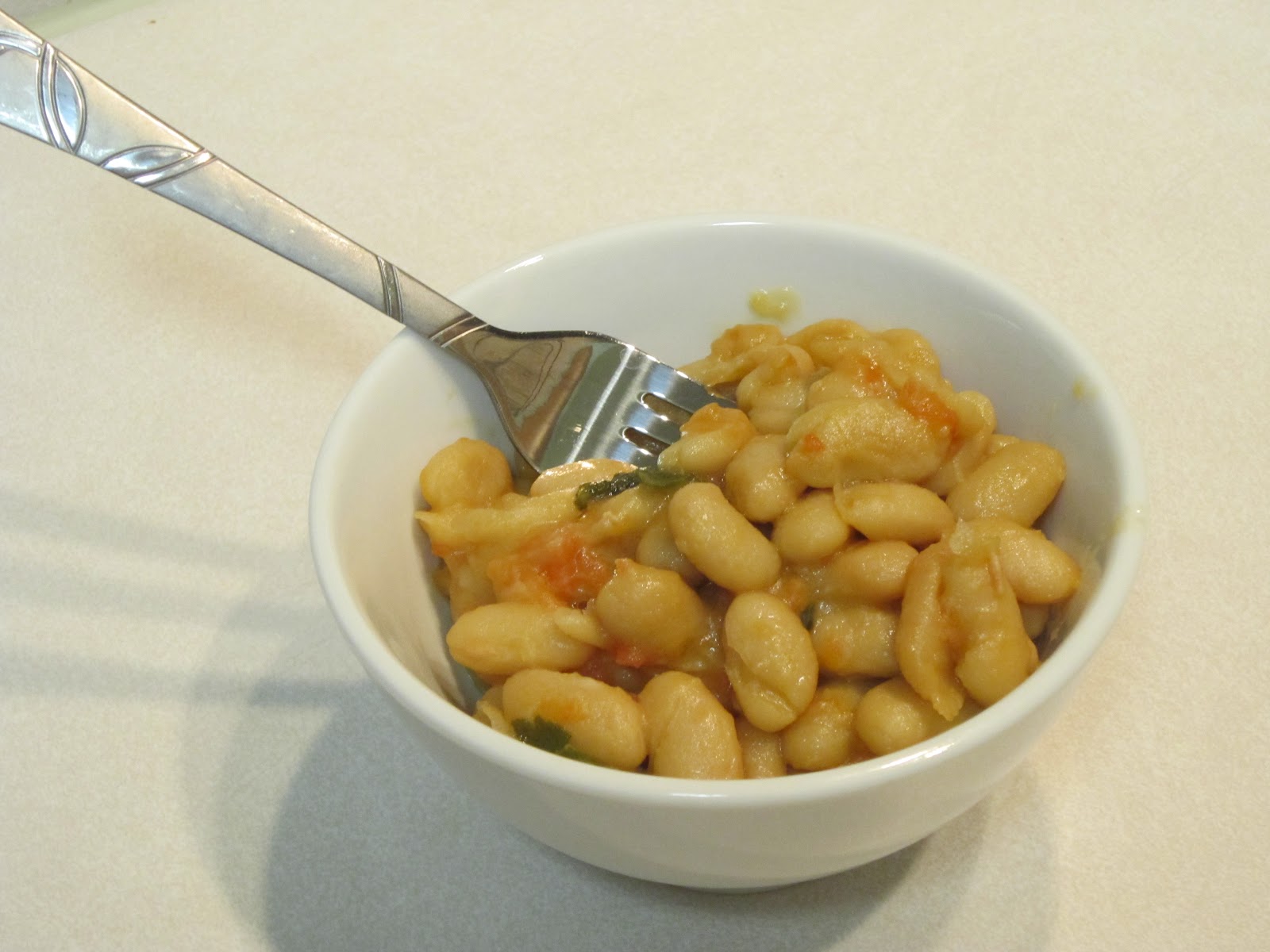
Fagioli all'Uccelletto
This is one of my favorite Tuscan recipes.
I hadn't heard of it before my Tuscan mentioned it to me one evening when I told him that I was planning to make Pasta e Fagioli for dinner that night. He said, "you should try to make Fagioli all'Uccelletto! I love it!"
Well, if my Tuscan loves it, I'm pretty certain I will love it too. And since I had all the ingredients on hand, I decided to give it a try.
This is a super easy, healthy recipe. I tend to eat it as a meal in itself, but you can use it as a side dish.
First, get your ingredients ready.
Peel two cloves of garlic and slice them fairly thin. Then take the blade of the knife and crush them a bit.
Wash the leaves, remove the stems and pat them dry.
Peel, de-seed and chop two Roma tomatoes finely.
Place a heavy pot over medium heat and add 1/4 cup (approximately 60 mL) of extra-virgin olive oil.
When the oil gets hot, add the garlic...
...and the sage.
Well, if my Tuscan loves it, I'm pretty certain I will love it too. And since I had all the ingredients on hand, I decided to give it a try.
This is a super easy, healthy recipe. I tend to eat it as a meal in itself, but you can use it as a side dish.
First, get your ingredients ready.
Peel two cloves of garlic and slice them fairly thin. Then take the blade of the knife and crush them a bit.
You'll need a few fresh sage leaves. I usually use 12 to 15 leaves, depending on their size and my mood. I love sage. You may decrease the amount of leaves, but I don't suggest going under 8 leaves.
Peel, de-seed and chop two Roma tomatoes finely.
Place a heavy pot over medium heat and add 1/4 cup (approximately 60 mL) of extra-virgin olive oil.
When the oil gets hot, add the garlic...
...and the sage.
Let it cook for a few minutes, stirring is every so often, until the garlic turns a golden brown and the sage leaves are crisp.
Then, add the tomatoes and let them cook for a couple minutes.
Add the drained and rinsed cannellini beans...
...and then add some water to one of your empty cans of beans (there can still be some bean goop in there when you add the water) and add enough of that water to just cover the beans.
Season with a little sea salt and freshly ground pepper, then let simmer for about 30 minutes. (The beans will be very soft when it is ready and it will not be as "wet".)
Serve hot alone or as a side dish. Buon appetito!
Fagioli all'Uccelletto
1/4 cup extra-virgin olive oil
2 cloves garlic, sliced thin and crushed
8 - 15 fresh sage leaves, stems removed
2 roma tomatoes, peeled, de-seeded, and chopped fine
2 cans cannellini beans, drained and rinsed
water
Heat 1/4 cup olive oil in a heavy pan over medium heat. When oil is hot, add the garlic and sage. Cook until garlic is golden brown and sage leaves are crisp. Add tomatoes and cook for a couple minutes, stirring occasionally. Add the beans. Add enough water to just cover the beans. Season with salt and pepper. Let simmer for 30 minutes or until the beans are very soft and the liquid is mostly gone. Serve hot.
Subscribe to:
Posts (Atom)