We visited St. Peter's immediately after touring the Vatican Museums, but unfortunately, we took the wrong exit out of the Sistine Chapel, so we didn't get the full effect of walking into St. Peter's Square (also known as St. Peter's Piazza) from Via Conciliazione. However, it was still extremely impressive to view the expansive square spread out in front of us as we walked out toward the front of the basilica.

The obelisk in the center of the square is huge - 25.5 meters tall (a little over 83.5 feet tall) - and has an interesting history behind it. Since it's first placement in Heliopolis, Egypt around 4400 years ago, it's been moved three times. First by the Emperor Augustus to Alexandria, then to Rome by the Emperor Caligula, and finally to where it stands now, in the center of the piazza in Vatican City. It's been here since 1586 and serves as the center of an extremely large sundial, laid out by the circular stones surrounding it.

The piazza itself is absolutely extraordinary. It's big, to be sure, but the way it is designed, it is really ingenious. Gian Lorenzo Bernini - who also designed the Trevi Fountain in Rome - designed the piazza to give an interesting perspective to the crowds of people who would gather there. The section of the piazza that is closest to the basilica is trapezoidal in shape, narrowing toward the larger, elliptical-shaped section. In doing so, it gives the illusion of the basilica as being closer than it actually is. The colonnade that surrounds the majority of the large piazza does not close off the piazza, but rather acts as welcoming arms, inviting and embracing all to the Church.
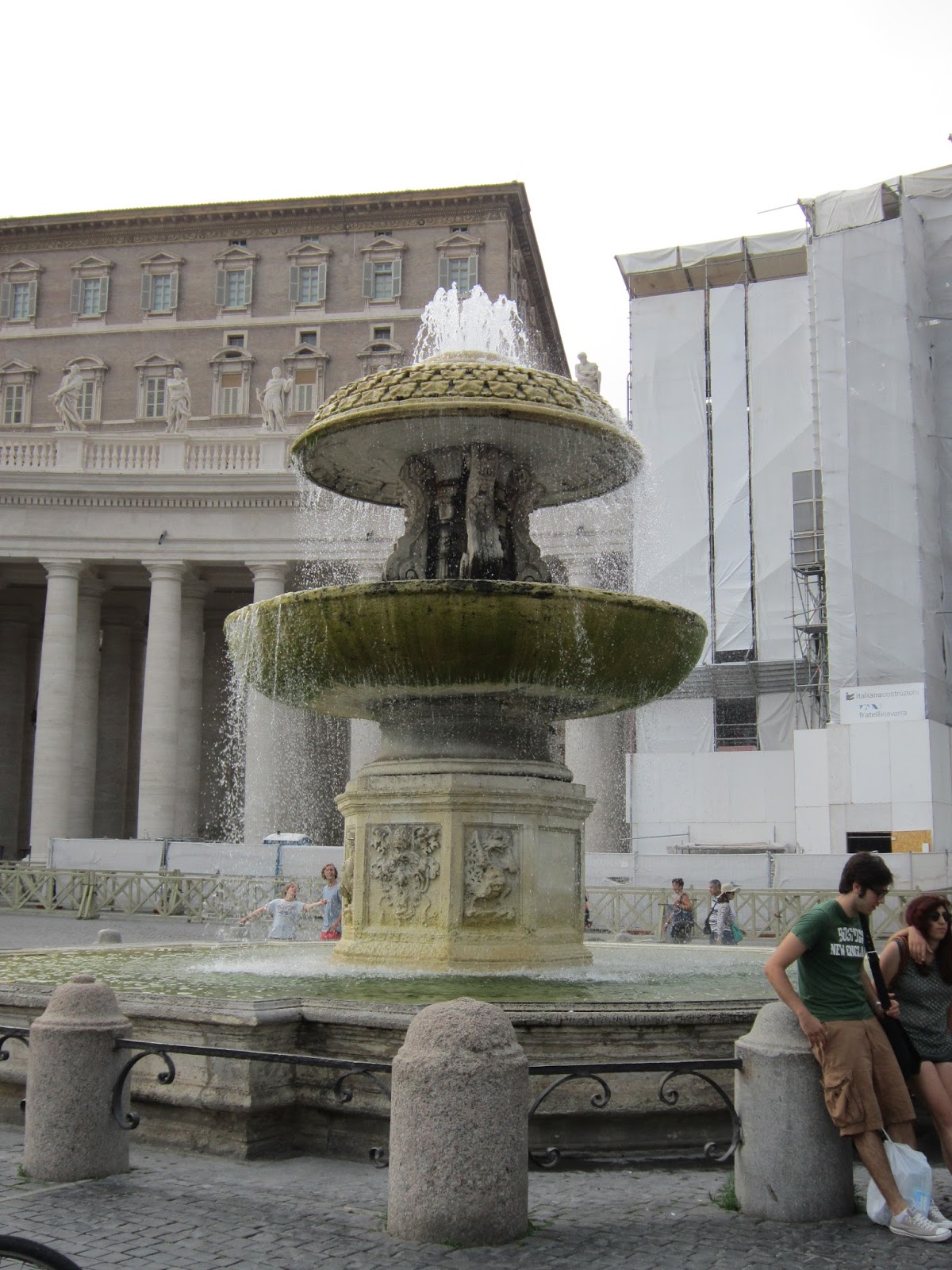 |
| One of the two fountains flanking the obelisk |
The basilica is really awe-inspiring. Walking up to the front of the church, I was struck by how tall the building is. It was exciting to see the balcony on which Pope Francis emerged after his being elected as Bishop of Rome only 4 months prior.

The long portico that stretches across the front is beautifully decorated with stone, stucco and marble. Light enters in from small windows along the top facing the piazza.

There are five doors leading into the basilica. Porta Sancta, the Holy Door, is the furthest on the right. From the inside, you can see that this door is completely walled up. The reason being is that it is only opened up during a Holy Year (also known as a Jubilee Year), which occur every 25 years (the last one being in the year 2000). The bronze door has 16 panels depicting scenes from the Bible.

We entered into the basilica through the Door of the Sacraments. Our first view of the soaring interior was incredible. All we could say was, "wow!" The sheer size of it left us awe-struck.

The large pilasters, the marble floor, the intricate details that can be seen at every turn...it was almost overwhelming. I walked over to one of the marble holy water fonts and blessed myself with the water.

As I stood at the font, my eyes lit upon the Chapel of the Pieta nearby. I grabbed Simone's hand and quickly walked over. I was completely mesmerized. Michelangelo's Pieta sculpture has been my absolute, hands-down favorite sculpture ever since I was a young kid and saw it in an art book. To stand in front of it and see it in person was absolutely amazing. The white marble glistened, as if it was wet.

The peaceful expression on Mary's face, the folds of her clothes, the muscles of the dead Christ in her arms...I could have stayed there and stared at it for hours. I wished that I could have gotten closer to see more of the details, but it is back behind a glass partition for protective purposes.
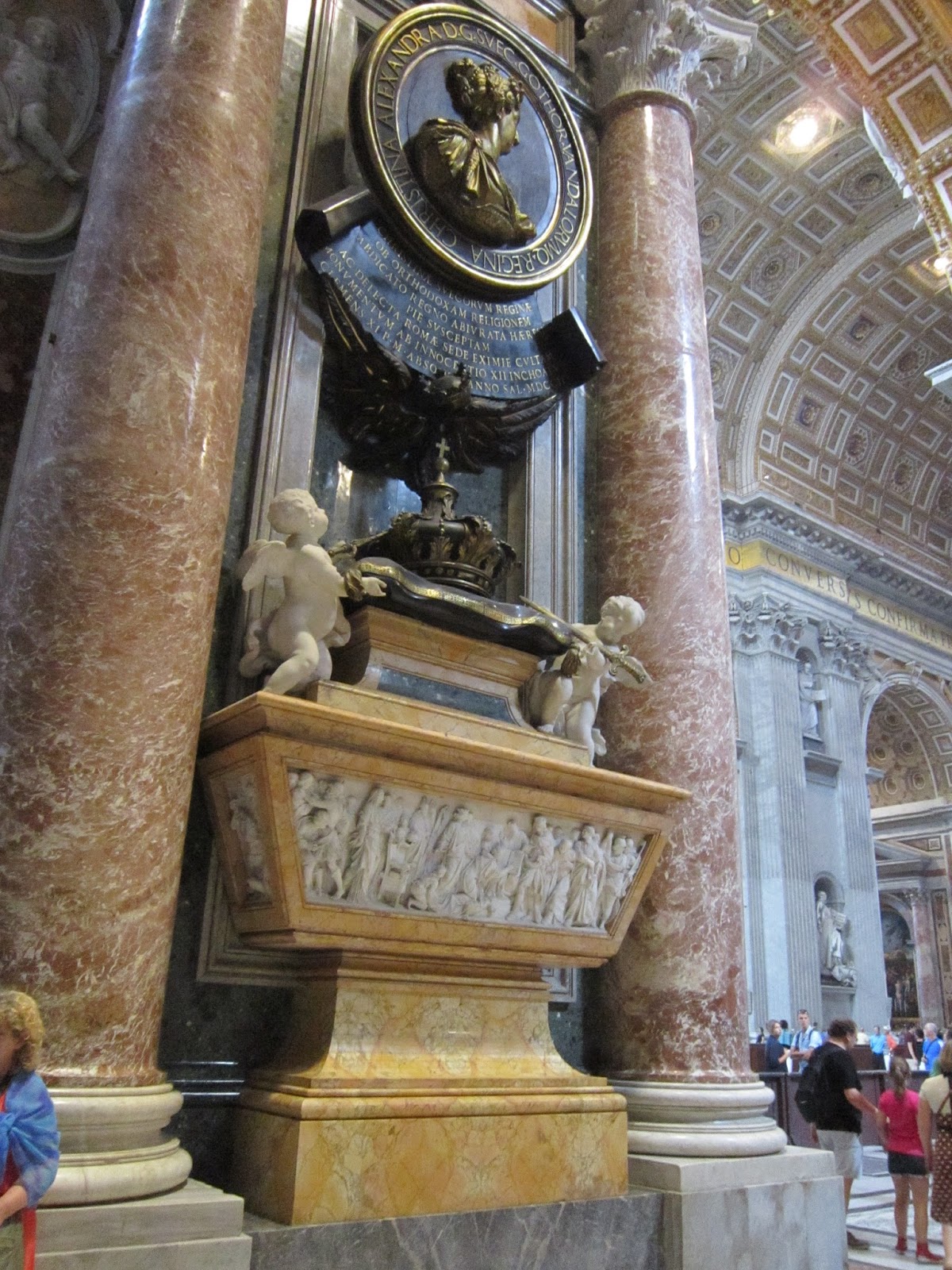
The next thing I happened upon was the monument to Christina of Sweden, who was Queen of Sweden, but abdicated her throne after converting to Catholicism in 1654.
Moving along the right side of the basilica, I immediately found myself standing in front of the Chapel of St. Sebastian, where lie the remains of Blessed John Paul II, soon to be declared a saint. There were several rows of seats with kneelers in front of the alter, under which is the late Pope's resting place. There were quite a few people praying. It was a very moving experience for me and I even shed a few tears standing there.


 |
| The dome above the Chapel of St. Sebastian |
The Blessed Sacrament Chapel was next. This chapel is closed off to all but those who wish to pray in front of the Blessed Sacrament. I snuck a picture through one of the windows.

There are tons of monuments to saints and popes throughout the basilica. This one is dedicated to Pope Gregory XIII...

...and this one to Pope Gregory XVI.

Walking toward the center of the basilica, I passed in front of the Chapel of St. Jerome, where the body of Blessed John XXIII is displayed below the alter. The late Pope's body is enclosed in a glass casket and he looks pretty good, considering he's been dead since 1963.

Around the corner from the Chapel of St. Jerome, there sits an ancient bronze statue of St. Peter. For hundreds of years, pilgrims and visitors to St. Peter's have traditionally touched and/or kissed the feet of the statue. Because of this, the feet are worn down smooth. (And yes, we did touch his feet!)

 |
| The "tapestry" behind the statue is actually a mosaic! |
The Right Transept (also known as the North Transept) is next to the statue of St. Peter. This area of the church is only open for people who are receiving the Sacrament of Reconciliation. Several confessionals with signage announcing the language spoken within are scattered around the transept.

 |
| Italian is the language spoken within this confessional |
From this point of view, turning around and looking down the nave, I was struck by how TALL this place is...and how bright it is. The sunlight streaming in from all of the upper windows and bouncing off all of the marble is just amazing to behold.

At the front of the basilica, is the main apse, which is an incredible sight to see. Above the alter is the Chair of Saint Peter. The actual chair is enclosed within a gilded bronze throne and was set above the alter in 1666. The alter, constructed of black and white marble and red jasper, is absolutely exquisite. Above it all is a gorgeous alabaster window of the Holy Spirit, portrayed as a dove on a golden background.

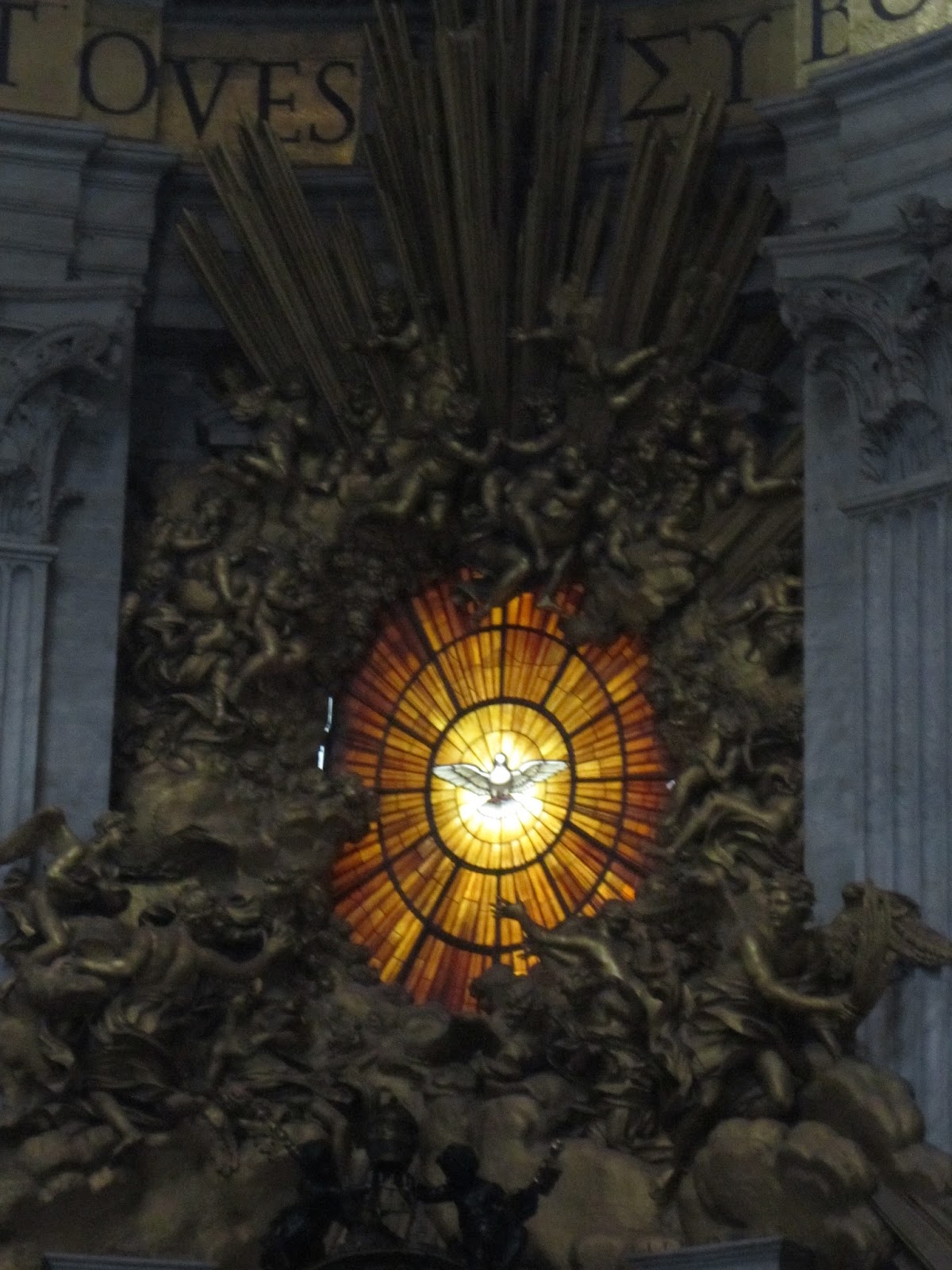
 |
| The Chair of St. Peter |
In front of the main apse is the Papal Altar and Baldacchino. The Papal Altar is (obviously) where the Pope celebrates Mass, was carved from a single block of marble and was consecrated in 1594. The bronze Baldacchino, whose canopy rises above the altar, was designed by the same Gian Lorenzo Bernini who designed St. Peter's Square (and contributed to other major parts of the basilica as well). This magnificent structure sits directly above the tomb of Saint Peter.

 |
 |
| The Papal Altar |
The grand dome of St. Peter's is directly above the Papal Altar and the Baldacchino. The 71 meter perimeter dome, designed by Michelangelo, reaches 120 meters above the floor. It is embellished by mosaic and stucco. The words "Tu es Petrus et super hanc petram aedificabo ecclesiam mean et tibi dabo claves regni caelorum" (Latin for "You are Peter and on this rock I will build my Church, to you I will give the keys of the kingdom of heaven") are inscribed on a gold band at the bottom of the dome. 16 windows are placed above this phrase. I really wish I got a better picture of the dome while we were there. The one below was taking on my iPhone, so the resolution isn't that great.

The Our Lady of the Column Chapel is to the left of the Papal Altar. I thought that this was an absolutely gorgeous chapel, with its light colors and gorgeous frescoes.

Next to that chapel is a huge monument to Pope Alexander VII. It's one of the most famous monuments in the basilica and is yet another work designed by Bernini - one which he designed when he was 80 years old. The travertine and marble sculpture is incredibly detailed. It includes the late Pope kneeling in prayer, death (portrayed as a skeleton), and four women, representing the four virtues.

The monument to Pope Pius VIII is next down the aisle and it is above the door to the Sacristy and Treasury Museum. The marble statue features a fantastic sculpture of Christ sitting on a throne with Saints Peter and Paul on either side and Pope Pius VIII kneeling in front.


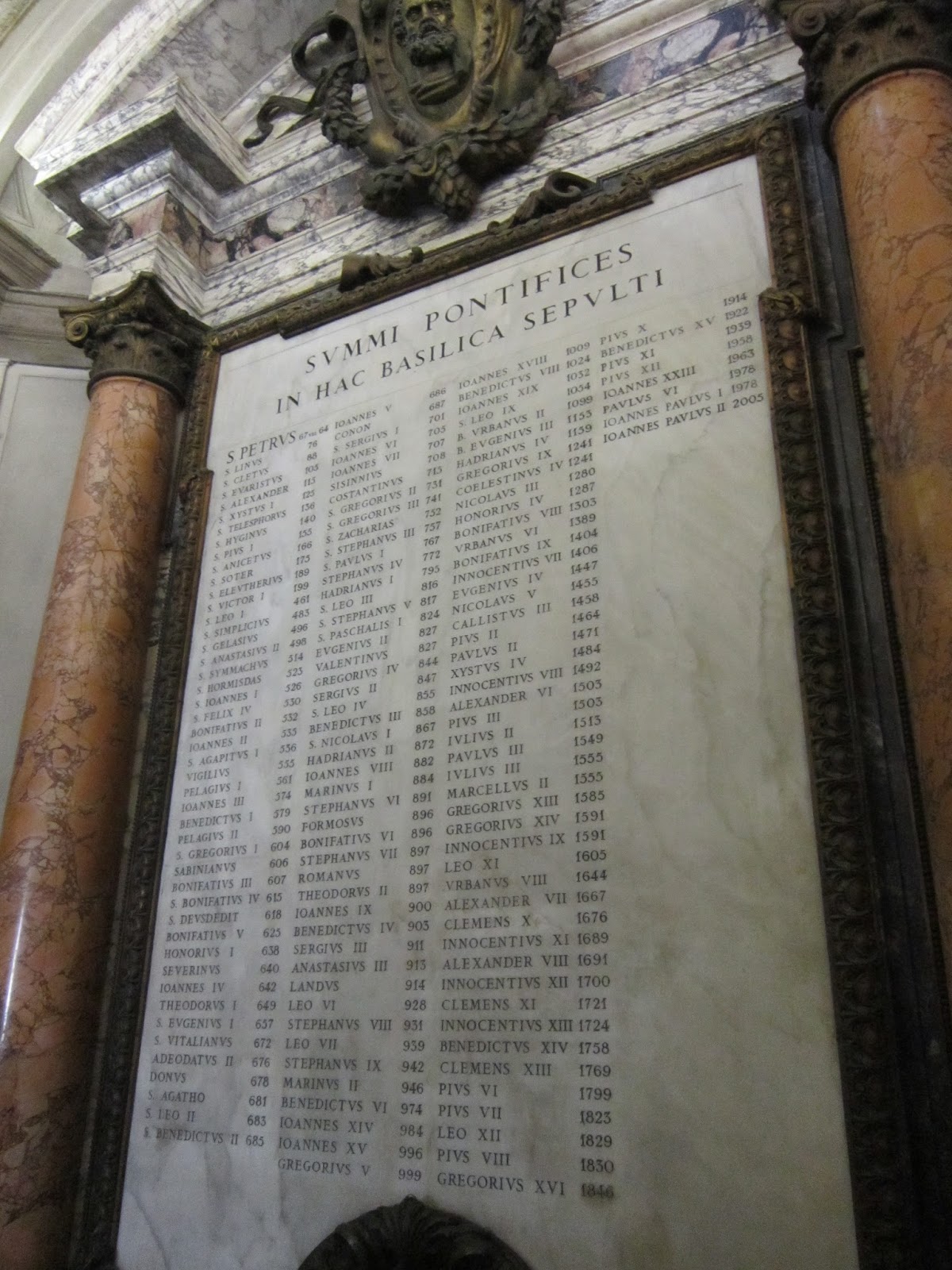
We walked through the door and saw the list of all of the former popes that are buried in the basilica. We didn't go through the Sacristy and Treasures Museum, though. Next time!
We stopped by to see Blessed Innocent XI, who rests beneath the Altar of the Transfiguration. This late pope is considered to be incorrupt, as his body was found to be unblemished when it was exhumed 267 years after his death. Today, his face and hands are covered in silver.

After that, we got to see the breath-taking Chapel of the Choir, with its fabulous Alter of the Immaculate Conception. The mosaic altarpiece is by Pietro Bianchi and the chapel itself was dedicated to the Virgin Mary, St. Francis of Assisi and St. Anthony of Padua. The remains of St. John Chrysostom, as well as relics of St. Francis and St. Anthony, are interred under the altar.

Leaving the basilica, we got to see two of the Pontifical Swiss Guards.

Even though we spent several hours in Vatican City, touring the museums and St. Peter's, we could have easily spend more time there. I definitely plan to go back again and take more time in this amazing place someday. The whole city-state is filled with so much beauty and art. The next time, I hope that we can take the tour of the Vatican Gardens and the Grottoes.
St. Peter's is free to enter, so really, there is no excuse not to visit if you are in Rome. It's an experience that I will never forget. Beauty at every turn and so much history in one place. It's absolutely incredible.