Friday, November 30, 2012

Il Pitto


Italy is full of history.  You can't visit the country without encountering something historical that is hundreds of years old...perhaps even over a thousand years old.  Ancient history abounds.  However, there is more "modern" history that can be found here as well.    

To the west of Signa, a town located about 20 minutes to the west of Florence, there is Il Pitto.

Il Pitto is a large villa, which can be seen on satellite views with a formal garden and surrounded by forest.  Looking in the forest, you can see what looks to be remnants of buildings from long ago, overgrown by trees and vegetation.


Simone and I were intrigued and curious about this area.  It is gated off and private.  There are security cameras at the gate on Via Santa Barbara.  What is this place?  What was this place?


After doing some research, we discovered that Il Pitto and the large area surrounding it, had been used as an explosives factory.  

In 1912, the property was purchased by Alfred Nobel's company.  The location was a good one for them - located at the confluence of the Ombrone and Arno Rivers in the central part of the country.  It was far enough away from enemy borders, yet close enough to the port at Livorno by rail. 


Nobel then developed the area, erecting buildings on the grounds and hiring hundreds of workers (at its peak, the complex employed around 3000 people).  The main road from Signa to Comeana that had passed through the property was moved and the vineyards that grew on the property were removed, replaced by a man-made forest.  Tall, dense trees were planted in order to camouflage the factory from the possibility of spy planes by enemy air forces.  The factory complex began to take the shape of a mini-city with roads, buildings and tunnels.


During WWI, the factory manufactured high caliber explosives/ammunition for cannons and dynamite.  After the war, in 1925, the factory and land was sold to Montecatini, a chemical and mineral/mining company that also acquired in the mid-1930's a general munitions and explosives company and formed Nobel-SGEM.  


Abandoned chemical laboratory
In the years of peacetime between the two wars, the area was utilized for agricultural experiments and experimental chemical production.  Then, with war once again looming, it resumed its explosives production, increased the amount of buildings on the property (now totaling over 100) and constructed a small rail system to transport materials between the various buildings and ultimately to the main railway.

Tracks of the small rail system
In 1944, the factory fell to the German Army who exploited it for their own use.  After this, the area became a target for sabotage by the resistance.  On 11 June, 1944, a few  members of the Italian Resistance attempted a major sabotage of the area by blowing up some of the wagons that were loaded with dynamite.  The group was successful.  The explosion destroyed the internal railway, created a huge crater near the Arno and destroyed many buildings.  However, four of the saboteurs - Alighiero Buricchi (19 years old), Bogardo Buricchi (23 years old), Ariodante Naldi (20 years old), Bruno Spinelli (42 years old) - were killed by the blast.  These brave men are considered heroes.  Because of their actions, all manufacturing at the compound ceased.

Monument to the fallen heroes
After the war, the factory was once again returned to its rightful owner, but because of peacetime, orders slowed and eventually ceased.  There were massive layoffs.  In a last ditch attempt to remain open, they once again changed their production from explosives to pesticides and plant production.  However, in 1958, the factory complex closed its doors forever.  In 1964, the area was cleaned of all explosive materials.  


Today, the villa "Il Pitto" is being utilized as a nursing home.  The villa and gardens surrounding it are lovely and in great shape.  Not far down a small road, however, the grounds where the factory complex existed are mostly overgrown by vegetation.  Although many of the buildings are crumbling, several buildings are surprisingly in good shape.  There have been discussions over the past few years on how to reclaim this area and the remaining viable buildings.  Everything from moving a University in to letting it be used by movie producers.  However, none of these ideas have yet to come to fruition and what is left of the old Nobel site sits empty and waiting.


Wednesday, October 31, 2012

At Home in Italy

I flew back to Italy on Monday.  The flights were uneventful.  Perfect landings on each leg of the trip (thank you Lufthansa pilots!) and we completely avoided tropical storm Sandy by flying over Greenland.  I started to get a little nervous at the start of my journey, since my flight to Chicago was delayed by almost an hour.  Seeing as Chicago is a ginormous airport and before I've had to run from one end of the airport to the other to get to my connecting flight, I was a bit nervous!  As luck would have it, the gate we pulled into upon arrival was only 5 gates down from my departing gate!  I got there in time to stand in line to board!

I didn't get much sleep on the flight over to Europe.  I was amused by the little dog that was under my seat.  The man sitting behind me had his dog as a carry-on & every so often it would let out a "yip".  Poor thing, I know it had to be his ears popping, because every time he "yipped" I noticed a change in pressure.  I do think that I prefer flying with a dog under my seat than a baby anywhere on the plane!

After watching 3 movies (Madagascar 3, Men in Black 3, and Brave) and a television episode (How I Met Your Mother), and maybe an hour and a half nap, I found myself in Frankfurt, Germany.  If you've never been to the Frankfurt airport, let me just say - it's huge.  I mean, REALLY huge.  I think every time I fly into Frankfurt that I end up walking the length of the city to get from one terminal to the other.  The people who work there are friendly though.  The female police officer who padded me down/wanded me at the security checkpoint and I shared a bit of a giggle over the fact that it was early in the morning and neither of us could remember the English word "collar"!

The flight to Florence was wonderful.  It is only about an hour and a half long flight, but the view of the alps is spectacular when there are no clouds.  As we passed over the mountains, they were covered in a blanket of snow and were absolutely magnificent!  Wish I would have gotten a picture of them, but I was too enraptured by them.

I took a short nap and awoke by the announcement that they had begun the descent.  I looked out the window & saw my Italy.  The brilliant green of the hills of Tuscany made me grin from ear to ear.  I felt the familiar feeling of contentment.  I was home!

After a perfect landing, decent bus ride to the terminal, and a short wait for my bags, I walked through the doors and sent Simone a text message that I was at the curb.  Within seconds, I saw him pull around with a big grin on his face.  I knew that I had missed him, but I hadn't realized how much until that moment.  A wonderful greeting accompanied by large grins and gleeful giggles.  Bags in the back and then we were off to the apartment that he found to rent.

The car ride took about 15 minutes or so from the airport to the outskirts of Signa.  The apartment is in a small village out in the countryside, near the Arno.  The owner, Francesco, met us there and discussed things with Simone.  I understood about half of what he was saying, which I thought was pretty good since I was exhausted!  For dinner that night, Simone cooked some riso dell'imperatore (Emperor's rice) with tomato and onion as well as some delicious crostini with onion, garlic and olive oil.

After the best night's sleep that I've had in months, we awoke to the sound of a sweet bird singing in the tree outside of our bedroom window.  The sun was out and it was a perfect morning.  We decided to go out and see the area, so we walked up and down the little street we are on and then hopped in the car for a drive up the mountain.  The views were spectacular.

View of the Arno from halfway up the mountain

View from the top of the mountain, overlooking Poggio a Caiano
My first 24 hours back in Italy were wonderful.  Stay tuned!

Saturday, July 7, 2012

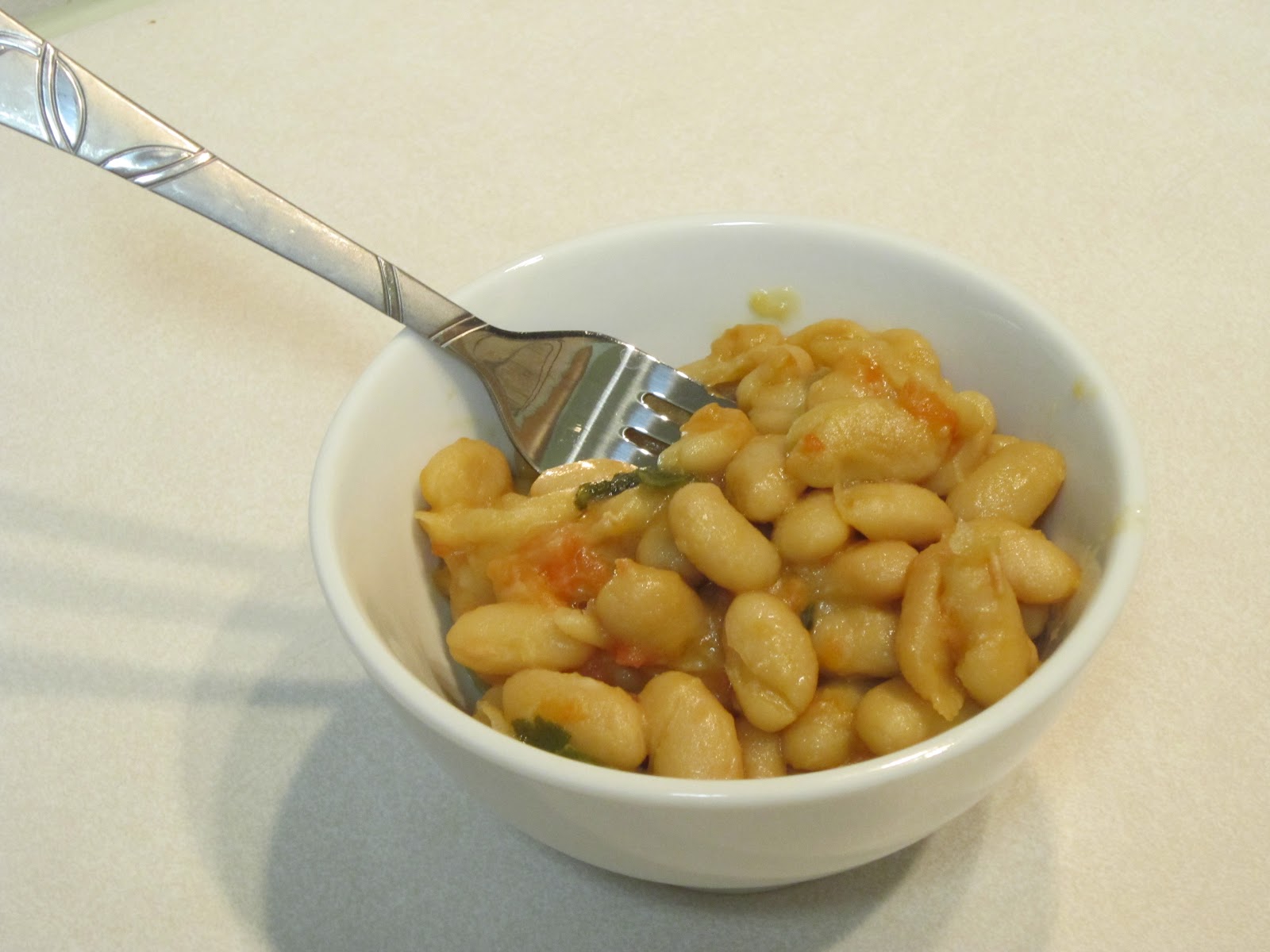
Fagioli all'Uccelletto

This is one of my favorite Tuscan recipes.


I hadn't heard of it before my Tuscan mentioned it to me one evening when I told him that I was planning to make Pasta e Fagioli for dinner that night.  He said, "you should try to make Fagioli all'Uccelletto!  I love it!"

Well, if my Tuscan loves it, I'm pretty certain I will love it too.  And since I had all the ingredients on hand, I decided to give it a try.

This is a super easy, healthy recipe.  I tend to eat it as a meal in itself, but you can use it as a side dish.

First, get your ingredients ready.

Peel two cloves of garlic and slice them fairly thin.  Then take the blade of the knife and crush them a bit.


You'll need a few fresh sage leaves.  I usually use 12 to 15 leaves, depending on their size and my mood.  I love sage.  You may decrease the amount of leaves, but I don't suggest going under 8 leaves.  


Wash the leaves, remove the stems and pat them dry.


Peel, de-seed and chop two Roma tomatoes finely.


Place a heavy pot over medium heat and add 1/4 cup (approximately 60 mL) of extra-virgin olive oil.


When the oil gets hot, add the garlic...


...and the sage.


Let it cook for a few minutes, stirring is every so often, until the garlic turns a golden brown and the sage leaves are crisp.


Then, add the tomatoes and let them cook for a couple minutes.


Add the drained and rinsed cannellini beans...


...and then add some water to one of your empty cans of beans (there can still be some bean goop in there when you add the water) and add enough of that water to just cover the beans.


Season with a little sea salt and freshly ground pepper, then let simmer for about 30 minutes.  (The beans will be very soft when it is ready and it will not be as "wet".)


Serve hot alone or as a side dish.  Buon appetito! 


Fagioli all'Uccelletto

1/4 cup extra-virgin olive oil
2 cloves garlic, sliced thin and crushed
8 - 15 fresh sage leaves, stems removed
2 roma tomatoes, peeled, de-seeded, and chopped fine
2 cans cannellini beans, drained and rinsed
water

Heat 1/4 cup olive oil in a heavy pan over medium heat.  When oil is hot, add the garlic and sage.  Cook until garlic is golden brown and sage leaves are crisp.  Add tomatoes and cook for a couple minutes, stirring occasionally.  Add the beans.  Add enough water to just cover the beans.  Season with salt and pepper.  Let simmer for 30 minutes or until the beans are very soft and the liquid is mostly gone.  Serve hot.

Sunday, June 24, 2012

The Arno River and the Bridges of Florence

When in Florence, it's hard to miss the Arno River.


This magnificent river flows from Mount Falterona (in the Apennines mountains), down through Florence, Empoli, and finally Pisa, where it deposits into the sea.

Several bridges span the Arno in Florence, all of which can be crossed a piedi (on foot) and all but the Ponte Vecchio permit cars to cross. From east to west, the bridges in order are:  Ponte alle Grazie, Ponte Vecchio, Ponte a Santa Trinita', Ponte Carraia, and Ponte Amerigo Vespucci.


Ponte alle Grazie


Originally built in 1227, it was rebuilt in 1345 and over the next two years had buildings attached, much like the Ponte Vecchio.  These buildings were removed in 1876 when a railway track was installed.  In 1944, German troops, retreating out of Florence, destroyed all but one of the bridges crossing the Arno, including the Ponte alle Grazie.  The current version of the bridge was completed in 1953 and is much more modern in design than the previous bridges.


Ponte Vecchio

The most famous bridge of Florence, the Ponte Vecchio (translation: "Old Bridge") is what is pictured on many postcards and travel brochures.  This bridge, in its current form, has been spanning the Arno since 1345 and is the only bridge in Florence that wasn't destroyed by the German Army in World War II.  For more on this bridge, please see my blog post from last November: here.


Ponte a Santa Trinita'


There has been a bridge at this location since at least 1252.  Originally built from wood, flood waters knocked that one down and a second bridge was built, but this version was also destroyed by a flood in 1333.  It was rebuilt once again, this time designed by Taddeo Gaddi (designer of the Ponte Vecchio) who used stone in the construction.  However, once again, it was destroyed by a flood in 1557.  Again, it was rebuilt.  Bartolomeo Ammanati designed it using stones from a local quarry.  Ammanati's version was finished in 1569 and 39 years later, four statues were added to the ends of the bridge in celebration of Cosimo II de Medici's wedding.


Unfortunately, this bridge was destroyed as well in 1944.  This time, it was not flood waters to blame, but war.  Once again, the bridge was rebuilt in the same location.  Thanks to Bernard Berenson, an American art historian living in Florence at the time, donations were gathered to rebuild it using the original materials.  This current version of the bridge is what stands today and is the world's oldest elliptic arch bridge.

Ponte alla Carraia


Originally built from wood in 1218 by the architect Lapo, the Ponte alla Carraia was destroyed by flood in 1274.  It was rebuilt with stone and wood, but this version of the bridge was also destroyed...this time not by flood waters, but by the weight of spectators, several of which died, in 1304 as they gathered to watch a show on the river.  It was rebuilt after the flood of 1333 (the first of the bridges of Florence to be rebuilt at that time), but was destroyed once again in 1557.  The next version of the bridge was designed by Bartolomeo Ammanati (designer of the Santa Trinita' Bridge), who was commissioned by Cosimo I de Medici.  The current version of the bridge was finished in 1948, after Ammanati's bridge was destroyed by German troops in 1944.

Ponte Amerigo Vespucci

Ponte Amerigo Vespucci in the distance
This bridge was originally built in 1949 with materials from the other bridges of Florence which were destroyed in 1944.  The current version of the bridge was built in 1957 after a competition was held for a new design.  What stands today is a very modern looking bridge, compared to the other bridges of Florence.  It has three spans and is supported by two piers.  With very clean lines and modern design, it resembles a ribbon stretched from one shore to the other.


To the west, the Parco delle Cascine runs along the Arno.  There, you can stroll along the Viale Abramo Lincoln and the Viale Giorgio Washington, which follow along the shoreline.


West of the Piazzale Kennedy in the Parco delle Cascine, you can find a pescaia, or "low dam", in the Arno, regulating the flow of the river.  (Note: there is another pescaia further upstream, betwee the Ponte Amerigo Vespucci and the Ponte Carraia.)


As you walk along the Viale, ending at the Piazzaletto dell'Indiano, you will see the Ponte all'Indiano, the first earth-anchored, cable-stayed bridge in the world, which was completed in 1978.  The bridge has two levels:  a level for pedestrians below and a level for cars above.


The Arno, itself, is a beautiful thing, yet it can also be quite temperamental.  There have been many floods over the centuries - the most recent being in 1966, which killed around 100 people and destroyed many priceless works of art after the river rose to above 6.7 meters (more than 22 feet) in less than 24 hours.

Simone pointing to a sign indicating the crest of the Arno on 4 November 1966

Since the flood of 1966, several engineering developments have taken place, such as the construction of the Bilancino Dam along the River Sieve, which is a major tributary to the Arno River.  With these projects, it is hoped that the devastating floods which happened in the past will be avoided in the future.


When visiting Florence, take some time to stroll along the Arno.  Take plenty of photos and be on the lookout for birds and wildlife who make the Arno their home.  It's a beautiful river that is well worth your time!

A Florentine Beaver at home on the Arno!

Saturday, June 16, 2012

Prato

If you're looking for a nice little side trip when you're visiting Florence, head out on the A11 (Autostrada Firenze-Mare) and in about 25-30 minutes, you'll find yourself in Prato.

Piazza Duomo - Prato

Prato's main industry, for centuries, has been textiles.  And where better to learn about that part of history than the Museo del Tessuto...the Textile Museum!  4 euros will get you a ticket in to see all sorts of examples of textiles, materials, tools an machinery that have been used throughout the ages.  (Note: photography in the museum is not allowed)

One building that you can't help but notice in Prato is the Castello dell'Imperatore.

Casetello dell'Imperatore (photo credit: Simone Cinotti)
Construction on this castle began around 1248 by Imperatore Federico II di Svevia as a way to keep the trade route from Germany under military control.  The castle is square with towers on the corners and in the centers of each wall.  The center of the castle, which used to house several buildings, is today completely empty.  They are currently renovating part of the castle and we were not permitted to enter it when we visited on a very rainy December morning, but we did get to take some pictures while standing in the doorway.

The interior of the castle (photo credit: Simone Cinotti)
An outside view of one of the towers

Directly across from the castle is Santa Maria delle Carceri, a basillica that was built in the 1480's.  Legend has it that a child saw a painting of the Madonna and Child come to life on the wall of the carceri (local jail), so it was decided to build a basilica at that place.  Lorenzo de Medici hired the architect, Giuliano da Sangallo, to design the church, which he did.  He took his inspiration from the Pazzi Chapel in Florence (designed by the famous Filippo Brunelleschi), and the final building favors that chapel quite a bit.

Santa Maria delle Carceri

About four blocks north west of Santa Maria delle Carceri is the Duomo di Prato, the Cathedral of St. Stephan.  There are documents supporting the fact that the church has been there since the late 10th century, but there is speculation that the church may very well have been there for some time before then.  The current church structure was built in the 12th century

Duomo di Prato (photo credit: Simone Cinotti)
Inside the church are beautiful frescoes by Filippo Lippi and Fra Diamante.  There are a few side chapels, one of which, the Cappella del Sacro Cingolo, houses a famous relic: a belt which, according to legend, was given by the Virgin Mary to Saint Thomas.

Interior of the Duomo

Exterior and the pulpit by Donatello (photo credit: Simone Cinotti)

Walk two blocks to the south of the Duomo and you will find yourself in the Piazza del Comune.  The Fontana del Bacchino is there...

Fontana del Bacchino (photo credit: Simone Cinotti)

...as is the Palazzo Pretorio, built in the late 13th, early 14th century, which used to be the City Hall.

Palazzo Pretorio (photo credit: Simone Cinotti)

Much like in Florence, the streets of Prato (especially in the historic city center) are lined with many small shops.  If you get the chance, stop by Antonio Mattei, which has been in existence at Via Ricasoli 22 since 1858, baking delicious treats, such as cantucci (a biscotto/cookie) or, my personal favorite, a torta mantovana (a cake with almonds and pinoli).

(photo credit: Simone Cinotti)

On your way in or out of Prato, take a moment and take a look at the city walls.  They've been protecting the city since the 1170's!

(photo credit: Simone Cinotti)
I would suggest spending a good part of a day in Prato, if not a whole day.  There is plenty to see and do.  If you enjoy art, there is a lot of it in and around the city, and surprisingly a lot of it is modern.  Of course, there are plenty of historical places to see as well, along with shopping and great places to eat.  If you are in the area and have some time, stop on by.  You won't be disappointed!

(A special thank you to Simone Cinotti, who took many of the photos of Prato after my camera battery died while we were visiting!)